
Studies of gel with immobilized semen by intrauterine endoscopy post-artificial insemination
Studies of gel with immobilized semen by intrauterine
endoscopy post-artificial insemination
Halldor Felde Berg, | Heidi Cecilie Larsen Spång | Bjørg Heringstad | Erik Ropstad1 | Anne Hege Alm-Kristiansen | Elisabeth Kommisrud
Reproduction in Domestic Animals, Januar 4, 2020
An extended lifespan of spermatozoa following artificial insemination (AI) can make
the timing of insemination less critical, as previously demonstrated with immobilized
spermatozoa that are gradually released from an alginate gel. The purpose was to
examine the in vivo dissolution of SpermVital (SV) alginate gel over time by endoscopy
and secondly to assess spermatozoa quality after incubation of the gel. In vivo
endoscopy showed SV gel in the uterus 3, 6, 20 and 24 hr after AI, demonstrating
the potential release of spermatozoa to the uterus during this period. In utero ex vivo
incubation of the semen demonstrated that high motility and viability of sperm cells
was sustained following overnight incubation.

Effect of SpermVital® technology on conception rate in repeat breeder multiparous dairy cows: preliminary results.
Effect of SpermVital® technology on conception rate in repeat breeder multiparous dairy cows: preliminary results.
Published in: Turkish journal of veterinary and animal sciences.
Authors: Alper KOÇYİĞİT, Barış Atalay USLU, Sait ŞENDAĞ, Elisabeth TREUPEL, Axel WEHREND 1Department of Reproduction and Artificial Insemination, Faculty of Veterinary Medicine, Cumhuriyet University, Turkey 2Clinic of Obstetrics and Gynecology, Faculty of Veterinary Medicine, Van Yüzüncü Yıl University, Turkey 3Clinic for Veterinary Obstetrics Gynecology and Andrology, Justus-Liebig-University, Giessen, Germany.
The aim of this study was to investigate the effect of SV technology on conception rates in repeat breeder multiparous dairy cows. Seventy-nine multiparous Holstein cows from a private dairy farm were used in the study. These animals were cows that had failed to conceive from at least 3 regularly spaced services (repeat breeders). Estrus cycles of the cows were synchronized by 2 injections of the PG analogue, administered 11 days apart. GnRH was applied 48 h after the second injection of PG. Twenty-four h after this administration, the animals were randomly divided into 2 groups, control and SV. The animals in the control group (n = 28) were inseminated with standard processed semen, and the cows in the SV group (n = 51) were inseminated with SV® technology processed semen. A lower pregnancy rate (35.5%) was determined in the control group than in the SV (47.1%) group. The difference between pregnancy rates in the groups was statistically significant (P < 0.05). We are at too early a stage to say that SV® Technology can fully respond to the deficiencies in herd management. This work may also lead to future studies into the use of more animal material.

Comparison of sperm adenosine triphosphate content, motility and fertility of immobilized and conventionally cryopreserved Norwegian Red bull semen
Comparison of sperm adenosine triphosphate content, motility and fertility of immobilized and conventionally cryopreserved Norwegian Red bull semen
Published in: Theriogenology volume 121, November 2018, Page 181-187
Authors: Halldor Felde Berg, Elisabeth Kommisrud, Godlove Bai, Eline Rustad Gaustad, Geir Klinkenberg, Fride Berg Standerholen, Lill Therese Thorkildsen, Karin Elisabeth Waterhouse, Erik Ropstad, Bjørg Heringstad, Anne Hege Alm-Kristiansen
Estrus detection and timing of AI remains a challenge in cattle breeding. Prolonging spermatozoa lifespan after AI, making sperm cells available over an extended period, could make timing of AI relative to ovulation less crucial and improve fertility. Immobilization of sperm cells by the patented SpermVital technology in an alginate gel will provide a gradual release of spermatozoa after AI. The first aim of this study was to examine fertility, measured as non-return rate after 56 days (NR56), of SpermVital (SV) processed semen with reduced sperm cell number per dose compared to earlier studies, and compare with conventionally processed semen in Biladyl, a proprietary version of the egg yolk Tris semen extender. The second aim was to examine in vitro sperm quality post-thaw and after thermal stress. The third aim was to examine potential correlations between in vitro sperm parameters and NR56. Ejaculates from 16 Norwegian Red young bulls were split in three, processed and cryopreserved as Biladyl semen (B15; 15 million spermatozoa/dose) or by SpermVital technology (SV25; 25 million spermatozoa/dose or SV15; 15 million spermatozoa/dose). 1400 semen doses were produced per bull and distributed throughout Norway for a blinded field trial. Fertility was recorded as NR56 after first AI (N = 7155). Two ejaculates from each bull were randomly selected for in vitro experiments. B15 and SV15 semen samples were analyzed for motility by computer-assisted sperm analysis, viability and acrosome integrity by flow cytometry and ATP content by bioluminescence assay, post-thaw and after thermal stress. The AI trial detected no differences in NR56; least square means being 75.5% (B15), 75.6% (SV25) and 74.8% (SV15) (p > 0.05). There were no differences in total motility and progressive motility post-thaw, however, after three hours incubation at 38 °C, SV sperm motility and progressivity were higher for SV15 than for B15 spermatozoa (p < 0.05). The percentage of acrosome intact live sperm cells was higher for SV15 than B15 spermatozoa at all timepoints analyzed (0 h, 3 h, 24 h, p < 0.05). B15 semen showed a higher ATP level than SV15 at 0 h (p < 0.05), while SV15 sperm cells had higher ATP levels after 3 and 24 h (p < 0.05). No association was detected between in vitro sperm parameters and NR56. In conclusion, SV15, SV25 and B15 semen yielded equal fertility after AI. However, there were differences in sperm quality, as SV15 spermatozoa displayed higher motility, viability and ATP levels after thermal stress than B15 spermatozoa (p < 0.05).
Performance of SpermVital Technology on Pregnancy Rate in Repeat Breeder Dairy Cows
Performance of SpermVital Technology on Pregnancy Rate in Repeat Breeder Dairy Cows
Poster by A. Kocyigit, B.A. Uslu, S. Sendag, A. Wehrend
DVG-VET-Congress, Berlin, Estrel Convention Center 9-12 November 2017

In vitro studies of Norwegian Red bovine semen immobilized and cryopreserved in alginate solid gel network
In vitro studies of Norwegian Red bovine semen immobilized
and cryopreserved in alginate solid gel network
AH Alm-Kristiansen | ER Gaustad | G Bai | FB Standerholen | G Klinkenberg | E Kommisrud | KE Waterhouse
Reproduction in Domestic Animals, 30 October, 2017
Contents
Development of new semen cryopreservation techniques improving sperm survival
and ensuring availability of viable spermatozoa for a prolonged time-period
after AI is
promising tools to reduce sensitivity of timing of AI and enhance overall fertility. The
SpermVital® technology utilizes immobilization of bull spermatozoa in a solid network
of alginate gel prior to freezing, which will provide a gradual release of spermatozoa
after AI. The objective of this study was to compare post-thaw
sperm quality and in
vitro sperm survival over time of Norwegian Red bull semen processed by the
SpermVital® (SV) technology, the first commercialized production line of SpermVital®
(C) and by conventional procedure applying Biladyl® extender (B). Post-thaw
sperm
motility was not significantly different between SV, C and B semen (p > .05). However,
sperm viability and acrosome intactness were higher for SV than C and B semen
(p < .05). Small differences in DNA quality were observed (p < .05). Sperm viability
after storage in uterus ex vivo was higher for SV than for C semen (p < .05). Furthermore,
sperm survival in vitro over time at physiological temperature was significantly higher
for SV semen than C semen as well as B semen during the incubation period of 48 hr
(p < .05). In conclusion, the SpermVital® technology is improved and is more efficient
in conserving post-thaw
sperm quality and results in higher sperm viability over time in vitro for SV than for C and B semen.
Reproductive performance of immobilized cryopreserved bovine semen used for timed artificial insemination.
Reproductive performance of immobilized cryopreserved bovine semen used for timed artificial insemination.
Anne Hege Alm-Kristiansen AH1,2, Gunnar Dalen G3,4, Geir Klinkenberg G5, Laila Bekk L2,Lill Therese Thorkildsen LT2, Karin Elisabeth Waterhouse KE2, Elisabeth Kommisrud E1,2.
Reproduction in Domestic Animals, July 9, 2017
The SpermVital® technology comprises embedding of spermatozoa within an alginate gel to facilitate release of sperm cells over a prolonged period in utero after AI. The aim of this study was to examine whether the survival time of spermatozoa is extended when applying this immobilization technology in combination with cryopreservation. Sperm cell survival (acrosome and plasma membrane integrity) was studied in vitro for 48 hr at physiological temperature. One dose of SpermVital® (SV) semen was compared with single doses of Biladyl® (B) processed semen as well as double doses of B (B double). B double was obtained by adding a second B dose the following day, thereby mimicking double AI. Furthermore, reproductive performance applying single early timed AI (TAI) with SV following oestrus synchronization was studied in a field trial. Double insemination (TAI on two consecutive days) with B semen served as control. Number of acrosome-intact live sperm cells decreased over time in vitro for all treatments (p < .05). There was no difference between SV sperm cell survival and B double after 24 hr (p > .05). However, after 48 hr, SV sperm cell survival was higher than B double (p < .05). Moreover, multivariate analysis showed that the outcome of single early TAI with SV was not significantly different from B double (p > .05). Likelihood of pregnancy and calving in the heifer group was higher than in the cow group (p < .05). These results imply that spermatozoa immoblized in alginate gel have prolonged survival.
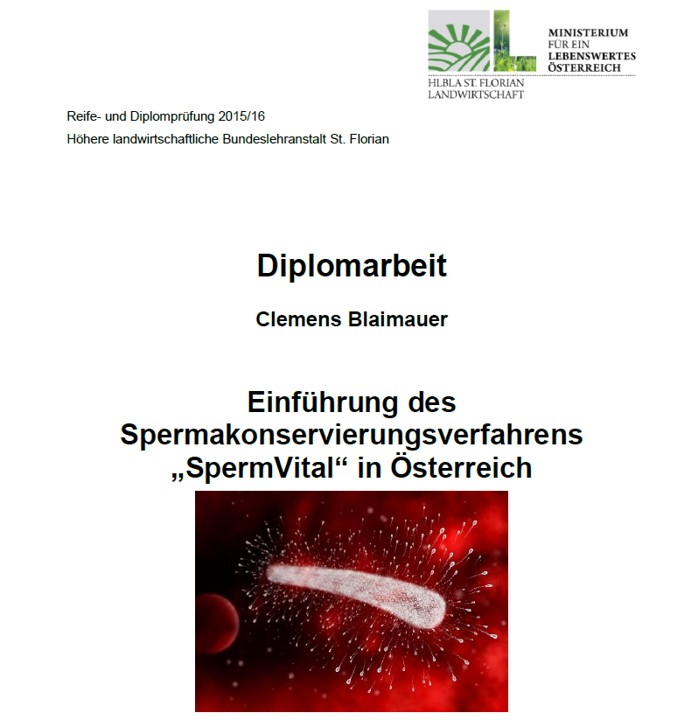
Einführung des Spermakonservierungsverfahrens „SpermVital“ in Österreich
Einführung des Spermakonservierungsverfahrens „SpermVital“ in Österreich
Diplomarbeit bei Clemens Blaimauer
Reife- und Diplomprüfung 2015/16
Höhere landwirtschaftliche Bundeslehranstalt St. Florian

This thesis deals with the launch of SpermVital, a new revolutionary technology which prolongs the lifespan of semen, in Austria. In the autumn of 2015, the Genostar Rinderbesamung GmbH started to sell the SpermVital technology to both dairy and beef farmers. The farmers in Austria will finally be getting the advantages of the SpermVital technology with increased flexibility and the ability of grouping inseminations together. The SpermVital technology will also help increase the pregnancy rates on repeat breeders. The advantages for the farmers are examined in this thesis.
The NRR 56 of standard processed bull semen was compared with the NRR 56 from SpermVital semen of agricultural operations, which intensively used SpermVital. The collected data were compared in a period of three months.
In a second step, the NRR 56 from SpermVital – insemination was compared with the average NRR 56 from Fleckvieh Niederösterreich.
The results show that SpermVital have at least the same fertilization results as standard processed bull semen. No potential improvements in the results have been found. The problem is that farmers use the expensive SpermVital technology for cows which have fertility problems. A correction for this problem is not possible because of the small data volume and that fertility is influenced by many factors.
Use of immobilized cryopreserved bovine semen in a blind artificial insemination trial
Use of immobilized cryopreserved bovine semen in a blind artificial insemination trial
Fride Berg Standerholen, Karin Elisabeth Waterhouse, Anne Guro Larsgard, Randi Therese Garmo, Frøydis Deinboll Myromslien, Jan Sunde, Erik Ropstad, Geir Klinkenberg, Elisabeth Kommisrud,
Theriogenology volume 84, Augus 2015, Page 413-420
To make timing of artificial insemination (AI) relative to ovulation less critical, methods for prolonging shelf life of spermatozoa in vivo after AI have been attempted to be developed. Encapsulation of sperm cells is a documented technology, and recently, a technology in which sperm cells are embedded in alginate gel has been introduced and commercialized. In this study, standard processed semen with the Biladyl extender (control) was compared with semen processed by sperm immobilization technology developed by SpermVital AS in a blind field trial. Moreover, in vitro acrosome and plasma membrane integrity was assessed and compared with AI fertility data for possible correlation. Semen from 16 Norwegian Red young bulls with unknown fertility was collected and processed after splitting the semen in two aliquots. These aliquots were processed with the standard Biladyl extender or the SpermVital extender to a final number of 12 × 106 and 25 × 106 spermatozoa/dose, respectively. In total, 2000 semen doses were produced from each bull, divided equally by treatment. Artificial insemination doses were set up to design a blinded AI regime; 5 + 5 straws from each extender within ejaculates in ten-straw goblets were distributed to AI technicians and veterinarians all over Norway. Outcomes of the inseminations were measured as 56-day nonreturn rate (NRR). Postthaw sperm quality was assessed by flow cytometry using propidium iodide and Alexa 488–conjugated peanut agglutinin to assess the proportion of plasma membrane and acrosome-intact sperm cells, respectively. In total, data from 14,125 first inseminations performed over a 12-month period, 7081 with Biladyl and 7044 with SpermVital semen, were used in the statistical analyses. There was no significant difference in 56-day NRR for the two semen categories, overall NRR being 72.5% and 72.7% for Biladyl and SpermVital, respectively. The flow cytometric results revealed a significant higher level of acrosome-intact live spermatozoa in Biladyl-processed semen compared to SpermVital semen. The results indicate that the level of acrosome-intact live spermatozoa in the AI dose did not affect the 56-day NRR for the two semen processing methods. In conclusion, this study has showed that immobilized spermatozoa provide equal fertility results as standard processed semen when AI is performed in a blinded field trial, although the immobilization procedure caused increased sperm damage evaluated in vitro compared to standard semen processing procedure.